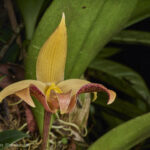
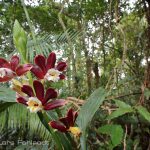
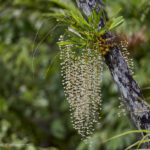
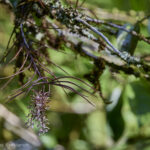
Beccari’s bulbophyllum, Bulbophyllum beccarii Rchb.f. – of Sarawak/Borneo – around 220m ASL.
From a botanical perspective, Bulbophyllum beccarii is an orchid species (family Orchidaceae) native to Borneo, which was first scientifically described in 1879 by Heinrich Gustav Reichenbach filius. The name is listed as accepted in today’s reference databases; the later neocombination Phyllorkis beccarii (Rchb.f.) Kuntze from 1891 is documented as a homotypic synonym. Bulbophyllum beccarii is by far the largest species of the genus Bulbophyllum and one of the largest in the orchid family, perhaps exceed only by Grammatophyllum speciosum. It is characterised by a strong, creeping rhizome covered with bristles; along this rhizome, pseudobulbs are spaced at intervals of about 15–20 cm, each bearing a single, leathery, bowl-shaped leaf that can reach a length of >50 cm. This ‘bowl shape’ is described in functional terms: The leaves can catch falling detritus and thus serve as an additional source of nutrients. The inflorescence is described as dense and cylindrical to spherical; the individual flowers are said to be around 15–18 mm wide and have a distinctly pungent odour (sometimes explicitly described in the literature as carrion-like), which is associated with fly pollination.
The genus name Bulbophyllum is derived from Greek (bolbos ‘tuber/onion-like’ and phyllon ‘leaf’) and refers to the pseudobulbs with the leaf sitting on top; The species epithet beccarii is a dedicatory epithet and refers to the Italian naturalist and botanist Odoardo Beccari (1843–1920), who is associated with botanical explorations in Malaysia, including Borneo.

related posts: