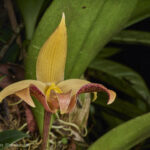
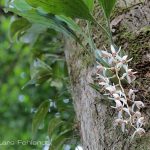
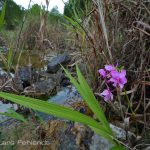
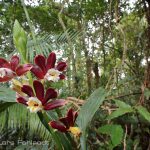
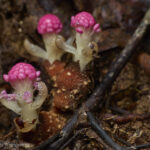
Coelogyne pholidotoides, J.J.Sm. 1903 (Kew) – of Sarawak/Borneo – around 1020m ASL.
Coelogyne pholidotoides is a species of orchid in the family Orchidaceae. Taxonomic literature lists it as native to Borneo, with evidence cited for Sabah, Sarawak and West Kalimantan. The species grows mainly epiphytically on tree trunks and branches in humid montane forests, occasionally also lithophytically on rocks (including sandstone), sometimes in exposed locations; it is reported to occur at altitudes of around 1000–1500 m. Morphologically, it forms pseudobulbs and has elliptical leaves. The inflorescences are multi-flowered and mostly pendulous; about 24–62 individual flowers are described. Flowering can occur synantherically, i.e. together with (almost) fully developed young leaves. Flowering times are given as June (uncertain), September–October and December, among others. The flowers are described as white to cream-coloured, with dark brown colouring on parts of the lip and yellowish markings; a slight fragrance is also mentioned. Nomenclaturally, the name was published by Johannes Jacobus Smith in 1903 in ‘Icones Bogorienses’. Etymology: The genus name Coelogyne is derived from Greek (koilos = “hollow”, gyne = “woman”/’pistil’) and refers to a sunken structure in the stigma area; The species epithet pholidotoides means ‘Pholidota-like’ and refers to a similarity between the flowering plant and species of the genus Pholidota.


related posts: