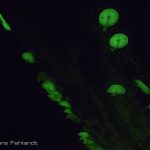
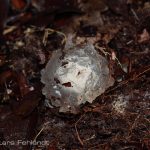
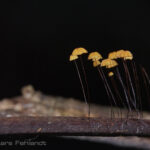
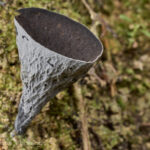
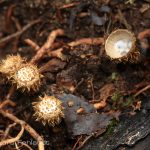
Cyptotrama sp. (Cyptotrama asprata (Berk.) Redhead & Ginns (1980)) of Sarawak / Borneo – around 900m ASL.
The genus Cyptotrama (Agaricales, Physalacriaceae) was validly described by Rolf Singer in 1960; Cyptotrama macrobasidium is given as the type species. In the original summary, the genus is characterized as “marasmioid” and distinguished from similar genera in particular by a bilateral lamellar trama (bilateral hymenophoral trama). In a later overview, Cyptotrama is summarized as a group of lignicolous (wood-dwelling), stipitate-pileate (stemmed and cap-shaped), non-radiculating, and non-viscous species with smooth spores. For Borneo, a literature checklist for Malaysia documents evidence of Cyptotrama asprata (also listed there as the current name for Xerulina asprata): findings mention Sabah (including Mount Kinabalu) and (dead) wood as the substrate; in addition, it is described as “usually solitary” and found in lowland and montane forests. The nutrition of these organisms is thus documented as saprobic on dead wood (decomposition of organic matter in the substrate); accordingly, fruiting bodies are formed on lying or dead wood.


related posts: