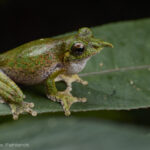
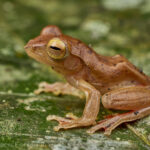
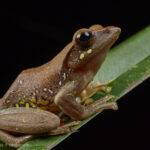
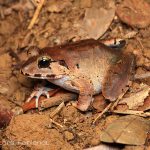
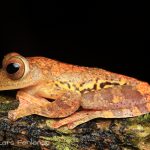
Fringed tree frog, Spicicalyx eucnemis (Lönnberg, 1900) with Myiasis of central Province / Papua New Guinea around 850m ASL.
Spicicalyx eucnemis (Lönnberg, 1900), commonly known as the Fringed Tree Frog or Growling Tree Frog, is an arboreal frog of the family Pelodryadidae. Formerly classified as Litoria eucnemis, it was transferred to the newly established genus Spicicalyx in 2025. In Papua New Guinea, the species is documented from the southern lowlands and the Huon Peninsula; its type locality is Sattelberg on the Huon Peninsula. Adult males measure approximately 38–48 mm and females 51–71 mm in snout–vent length. Distinguishing features include extensively webbed fingers and toes, a conspicuous triangular projection on each heel and crenulated dermal fringes along the forearms and hindlimbs. It is a nocturnal rainforest species associated with permanent, generally slow-flowing streams. The frogs are arboreal, while breeding activity occurs beside streams, where males call from low vegetation; the advertisement call consists of a series of short, soft growling or guttural notes. The generic name Spicicalyx combines the Latin spica, meaning “point” or “spear”, with calx, meaning “heel”, and refers to the characteristic heel spike. The specific epithet eucnemis is derived from the Greek eu, meaning “well” or “good”, and knēmis, meaning “leg”, “shin” or “greave”; however, Lönnberg did not explicitly explain the intended reference in the original description.
Notably(!), a fly larva was observed on the hind limb of each of two individuals. In both cases, the larva was situated superficially on the skin and had not penetrated into the underlying tissue. The observations are therefore consistent with a possible superficial form of cutaneous myiasis rather than a subcutaneous infestation. However, identification of the larvae and evidence that they were actively feeding on the host would be required to confirm myiasis and determine the fly species involved.


related posts: