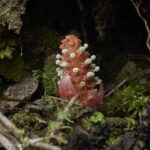
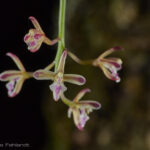
Balanophora sp. is a parasitic flowering plant of the Balanophoraceae family – of Kalimantan/Borneo – around 900m ASL.
Balanophora is a genus of fully parasitic flowering plants (family Balanophoraceae, order Santalales) whose range includes parts of Southeast Asia, including Borneo. The genus name is explained in botanical name scholarship as “acorn-carrying,” referring to the acorn-like shape of the above-ground inflorescences. These plants are root holoparasites: they lack chlorophyll and obtain their entire water and nutrient supply from the roots of their host plants via specialized contact/absorptive structures at the host–parasite interface. In the Malaysian part of Borneo (Sabah), five Balanophora taxa have been documented on Mount Kinabalu (B. fungosa subsp. fungosa, B. elongata, B. lowii, B. papuana, B. reflexa), and in that treatment B. fungosa subsp. fungosa and B. elongata were explicitly reported as new records for Borneo. The above-ground inflorescences, typically yellow to red, emerge from tuberous structures attached to host roots; for some species, pollinators reported include ants, flightless cockroaches, and moths, and both self-pollination within an inflorescence and outcrossing have been described.


related posts: