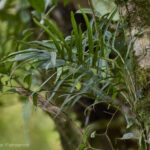
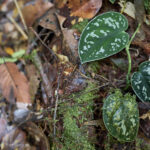
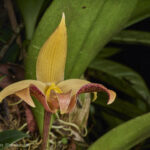
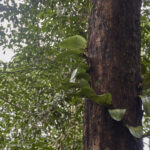
In situ Licuala cordata Becc. of Sarawak/Borneo – around 600m ASL.
Licuala cordata Becc. (Arecaceae, Arecales) was first described by Odoardo Beccari; it was first published in Malesia 3: 84 (1886). According to Plants of the World Online, the species is native to Borneo (Sarawak) and is accepted as a name; two infraspecific taxa are also accepted (L. cordata var. cordata and L. cordata var. ashtonii). In the revision of the genus Licuala for Borneo, L. cordata is described as a small, short-stemmed palm that can grow solitarily or in clumps (up to approx. 1 m high; crown with 11–18 leaves); the petiole can be 110–162 cm long. The fruits are described as ellipsoid, about 1 cm wide and smooth (unripe green), the seeds as spherical. Within the species, var. cordata is characterised, among other things, by an undivided, approximately round leaf blade (orbicular-flabellate, entire margin; overlapping at the base when fresh; leaf blade dimensions approx. 103–122 × 93–105 cm); the Belaga district (Sarawak) is given as the location for this variety. Its habitat is described as mixed dipterocarp forests on slopes and in valleys (250–440 m); due to its small area (EOO < 200 km²) and factors such as logging and the risk of flooding in connection with the Bakun Dam mentioned in the text, var. cordata is classified as ‘Endangered’. In contrast, the variety ashtonii (published in 2012) has ‘windows’/slits in the otherwise undivided, peltate-round leaf blade (incomplete slits from the hastula area to approx. 4–6 cm before the leaf margin). Belaga (Sarawak) is also mentioned for var. ashtonii, whose habitat is mixed dipterocarp forest at around 500 m, and due to its very small area (EOO < 10 km²), it is classified as ‘Critically Endangered’; its suitability as an ornamental plant is explicitly mentioned as a use.
Etymologically, the genus name Licuala is given as a Latinisation of the vernacular name ‘leko wala’ (for the type species Licuala spinosa); the species epithet cordata is botanical Latin and means “heart-shaped” (cordate).


related posts: