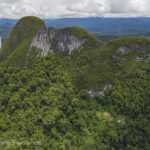
Anyone spending some time in Tomohon should not limit themselves solely to the impressive volcanic landscape and the surrounding rainforests, but should also visit the places where the local people go about their daily lives. I always find the traditional markets particularly interesting. They not only serve to provide the local population with their daily necessities, but also offer a direct insight into the culture, culinary traditions and way of life of a region.
The fact that the market we visited is also known as Pasar Ekstrim – or ‘Extreme Market’ – should, however, have made me suspicious beforehand.


The culinary diversity of the highlands
At first glance, the market hardly differs from many other traditional markets in South-East Asia. Numerous traders offer fresh fruit, vegetables, spices, traditional sweets and freshly baked pastries. The colours, smells and variety of food on offer always make a visit to such a market a special experience.
The comparatively cool climate of the Tomohon highlands and the fertile volcanic soils provide excellent conditions for growing a wide variety of vegetables. As well as carrots, cabbage, tomatoes, aubergines and spring onions, the region also cultivates chayote, various leafy vegetables and numerous varieties of chilli.


Chillies, in particular, play a prominent role in Minahasa cuisine. Together with ginger, turmeric, lemongrass, garlic and aromatic herbs, they form the basis of many traditional dishes. The cuisine of North Sulawesi is renowned throughout Indonesia for its exceptional heat and intense flavours.
The region’s range of tropical fruit is equally diverse. Depending on the season, traditional markets offer bananas, papayas, mangoes, pineapples, rambutan, mangosteen, salak and, of course, durian. Many of these fruits are either difficult to find in Europe or have already lost a significant portion of their original flavour due to the long distances they have to be transported.
The durian, in particular, holds a special place in South-East Asia. Whilst its intense smell is met with distaste by many people, elsewhere it is regarded as a culinary delicacy and is, not without reason, referred to as the ‘queen of fruits’.
The fact that this particular fruit has a direct ecological link to what is on offer in another section of the market makes the visit particularly interesting from a scientific perspective and, at the same time, deeply thought-provoking.


The fish trade and the importance of intact coral reefs
Although Tomohon lies in the volcanic highlands, the sea is not far away. Consequently, there is a wide selection of fresh fish on offer at the market. Alongside yellowfin tuna (Thunnus albacares), however, there were also numerous fish here that, from an ecological point of view, would have been better left in the sea. Particularly striking was the large number of parrotfish (Scarinae) on offer.
These often exceptionally colourful inhabitants of tropical coral reefs perform important ecological functions, the significance of which extends far beyond their role within the marine food chain.
Many parrotfish feed on algae and other organisms that grow on the calcareous substrate of coral reefs. Through their continuous feeding, they limit algae growth and create clear areas of substrate on which, amongst other things, coral larvae can settle.


If these natural grazers are absent, or if their populations are severely depleted by intensive fishing, the ecological balance of a reef can be disrupted. Particularly following coral bleaching or other disturbances, algae can spread and hinder the regeneration of damaged coral reefs.
However, parrotfish fulfil yet another fascinating function. With their powerful, beak-like teeth, many species grind away parts of the calcareous reef substrate whilst feeding. This material is further broken down by specialised pharyngeal teeth and eventually excreted as fine carbonate sediment.
In this way, parrotfish play a key role in the formation of the white sandy beaches that are so characteristic of many tropical islands. Scientific studies in the Maldives have shown that, in certain reef systems, parrotfish can be responsible for more than 85 per cent of biological sediment production.
So, anyone walking along a white sandy beach on a tropical island may well be walking, to a considerable extent, on material that has previously passed through the digestive tract of a parrotfish.
Given the increasing pressure on tropical coral reefs from rising sea temperatures, coral bleaching, marine pollution and overfishing, I personally find it particularly questionable to intensively fish for precisely those animals that make such an important contribution to the stability and regeneration of these sensitive ecosystems.


The culinary traditions of the Minahasa
The Minahasa are one of the largest ethnic groups in North Sulawesi and possess a distinct cultural and culinary identity that differs markedly from many other regions of Indonesia.
Whilst Indonesia is predominantly Muslim and religious dietary laws restrict the consumption of certain animal-based foods, the Minahasa population is predominantly Christian. Consequently, such religious restrictions play a much lesser role for many people here.
Added to this are hunting traditions that have developed over time and the use of the natural resources of the surrounding forests. The consumption of game has been an integral part of the regional food culture for generations. Certain game dishes are considered delicacies and are served in particular at family celebrations, weddings and other social gatherings.
However, it would be wrong to attribute the consumption of wild game solely to a historically driven need for protein. Taste, tradition, social identity and the demand for particular types of meat also play a role.
What may originally have served to provide for individual village communities has, in some respects, developed into a commercial trade in wild game. The growing demand may far exceed what natural populations can sustain in the long term.
Of course, this does not mean that all members of the Minahasa people equally uphold or endorse these traditions. Even within the local population, there are differing views on the consumption of wild animals, as well as dogs and cats.
The other side of the market
Note regarding the photographs below: This section contains images of killed animals and, in some cases, disturbing depictions of the meat trade. The relevant images are therefore initially displayed out of focus.
Whilst the part of the market where fruit, vegetables and fresh baked goods are on offer appears extremely inviting, the picture changes fundamentally as soon as one approaches the stalls where meat is sold and processed.
In addition to conventional cuts of meat, reticulated pythons (Malayopython reticulatus), the forest rat (Rattus xanthurus) – endemic to Sulawesi – and various species of flying foxes (Pteropodidae) are also on offer here.
I have previously encountered the trade in flying foxes at several markets in South-East Asia. What I found particularly striking in Tomohon was that the animals’ bodies and their wings were apparently sold separately. It would seem, therefore, that even the wings are used for culinary purposes.
From a species conservation perspective, the intensive hunting of flying foxes is particularly problematic. In parts of South-East Asia, commercial hunting has already led to the disappearance of local populations. On Sulawesi, too, numerous roosting colonies are under considerable hunting pressure.
As fruit bats have a very low reproduction rate compared to many other small mammals, and most species give birth to only one young per year, decimated populations can recover only very slowly.


When the hunting of wild animals becomes an economic problem
Much like the parrotfish mentioned earlier, the ecological importance of fruit bats is also frequently underestimated.
Yet, as pollinators and seed dispersers, they perform vital functions within tropical ecosystems. Through their sometimes considerable night-time flight distances, they transport pollen and seeds over vast distances, thereby contributing to the natural regeneration and genetic connectivity of plant populations.
A particularly striking example of this is the durian tree (Durio zibethinus).
Its flowers mainly open in the evening and are visited in particular by nocturnal bats. Scientific studies on Sulawesi have shown that flowers accessible to bats had a significantly higher fruit set than those that could only be visited by insects.
Intensive hunting of these animals therefore not only poses a threat to biodiversity but may also have direct economic consequences for the local population in the long term.
It is a striking contradiction that, on one side of a market, animals are sold whose ecological services contribute to the production of the very fruits that may be on sale just a few metres further on.
Both the parrotfish and the flying foxes illustrate just how closely human economic interests are linked to the functioning of natural ecosystems. The short-term financial gain from selling these animals stands in contrast to the potentially far greater long-term benefits of maintaining living populations.


Between tradition and animal welfare
However, among the most disturbing sights for me were the dogs and cats on offer. The animals’ fur had already been singed off, yet their characteristic morphology meant I could still clearly recognise them as such.
This observation is particularly noteworthy given that the sale of dog and cat meat at Tomohon market was officially banned as early as July 2023. However, the animals I encountered during my visit in November 2026 raise doubts as to how consistently this ban is being enforced in practice.
During our stay, we were also told that during a previous eruption of Gunung Lokon, numerous wild animals had fled from the surrounding forests towards the valley. According to local accounts, villagers had seized this opportunity to kill many of the fleeing animals and subsequently sell them at the market.
I was unable to independently verify whether, and to what extent, this actually took place. Nevertheless, the idea that animals fleeing a natural disaster subsequently become prey to humans themselves left a lasting impression on me.
Hygiene conditions and health risks
Apart from issues of animal welfare and species conservation, I found the hygiene conditions in that part of the market where meat was on sale and being processed on the spot to be particularly worrying.
There were meat scraps, congealed blood and other processing residues on the floor. In some areas, one had to be careful not to slip on the dirty floor whilst walking. The condition of individual stalls and their immediate surroundings gave me the impression that thorough cleaning and disinfection were not being carried out adequately.
Health risks can arise, particularly where different species of wild animals are processed under such conditions. Direct contact with animal bodily fluids, contaminated surfaces and raw meat can facilitate the transmission of various pathogens.
This applies not only to visitors to such markets, but also, in particular, to those people who are involved in the processing and sale of the animals on a daily basis.


My personal conclusion
The traditional market in Tomohon is undoubtedly worth a visit. Its variety of fresh food, colourful displays and everyday hustle and bustle provide an authentic insight into the lives of the local population and the culinary culture of the Minahasa.
The part of the market where meat is sold and processed, however, left me with a decidedly distressing impression.
Through my numerous stays in tropical regions and my work in the rainforests, I have already encountered many different ways of utilising natural resources. Not every cultural tradition has to conform to our own ideas. For me, however, cultural understanding does not mean having to accept all practices uncritically.
Particularly where traditional customs, driven by commercial demand, lead to the unsustainable exploitation of natural resources, the long-term ecological consequences must also be taken into account. The same applies to avoidable animal suffering.
Whether in the rainforests of Sulawesi or in the coral reefs off its coast, the loss of individual animal species never affects only those species themselves. It can have far-reaching effects on entire ecosystems and, ultimately, on the people who depend on their functioning.
Anyone visiting Tomohon should certainly take a look at the market and its culinary diversity. However, whether one wishes to visit the part of the market where wild animals, dogs and cats are on sale is a decision each person must make for themselves.
Some impressions stay in your memory far longer than you wish.