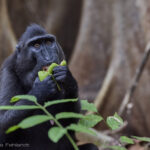
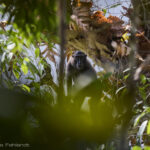
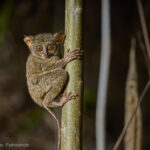
The Celebes crested macaque – Macaca nigra (Desmarest, 1822) – North Sulawesi / Indonesia.

The crested macaque (Macaca nigra), known internationally as the Celebes crested macaque and locally as the Sulawesi crested macaque, is one of the most remarkable primates on Sulawesi. The species is endemic to the northern peninsula of Sulawesi. Another population exists on the island of Bacan, to which the animals were introduced by humans in the 19th century.
Characteristic features include its entirely black fur, distinctive crest and striking reddish calluses on the buttocks. The animals live in large social groups comprising several adult males and females, whose coexistence is characterised by complex social relationships, dominance hierarchies and diverse forms of communication.
Of particular interest is the comparatively high level of social tolerance exhibited by this macaque species. Scientific studies show that conflicts within the groups are frequently regulated through ritualised threatening gestures and reconciliation behaviour. Crested macaques are thus among the more socially tolerant members of their genus.
Since 2006, the international Macaca nigra Project, in collaboration with the German Primate Centre (DPZ), has been studying the social behaviour, population dynamics and ecology of wild crested macaques in the Tangkoko Conservation Area.
Individual groups have been under scientific observation for many years. These include the Rambo 1 (R1), Rambo 2 (R2) and PB (originally Pantai Batu) groups. Long-term monitoring of individually identified animals makes it possible to document changes in group composition, social relationships and shifts in dominant males.
During my stay, I had the opportunity to observe three of these groups over different periods. I was accompanied by a local guide who had himself worked with the scientists for six years, collecting behavioural data.


Our first encounter took place rather by chance. We had already been waiting for several hours by a nesting tree of the knobbed hornbill (Rhyticeros cassidix) when a group of crested macaques suddenly approached.
These were animals from the original PB group. This group had previously comprised more than 100 individuals, but had split into several smaller groups over the years. It was not possible to determine which of these sub-groups the observed animals belonged to.
The macaques roamed the area in search of food, paying us hardly any attention. Some animals scoured the forest floor, whilst others climbed into the trees. After about 30 minutes, the group moved on and some of them disappeared into the canopy.


The following day, I set out specifically to look for more groups of macaques. After several kilometres through the forest, we finally came across Rambo 1.
The group was busy foraging for food. Several older animals were perched in fruit-bearing fig trees, whilst younger macaques searched the ground for fallen fruit. Figs of the genus Ficus are an important food source for crested macaques, which, as predominantly fruit-eating primates, also play a significant role in the dispersal of plant seeds.
We followed the group for several hours, taking care to maintain a sufficient distance. I largely avoided direct eye contact, as sustained staring can be perceived as a threat by macaques. Occasionally, the dominant male made it clear when I was getting too close. He bared his powerful canines and made repeated head movements. Such threatening gestures form part of the species’ complex communication repertoire and serve, amongst other things, to establish distance and resolve conflicts without immediate physical confrontation.


The foraging took place under exceptionally difficult environmental conditions. The months-long drought associated with the El Niño event had affected large parts of North Sulawesi. In addition, severe forest fires had swept through the Tangkoko Conservation Area just a few weeks earlier. According to local reports, around 60 hectares of forest had been completely burnt, whilst a further estimated 100 to 200 hectares had been affected to varying degrees. The consequences were clearly visible in the forest.
The availability of fruit and other food resources for crested macaques is significantly influenced by climatic conditions. Scientific studies also show a correlation between the seasonal food supply and the size of the foraging ranges used. However, the extent to which the exceptional drought and the forest fires influenced the daily movements of the group I observed cannot be determined from the observations alone.


After several hours, Rambo 1 reached a small hill where the animals stopped to rest. We, too, took the opportunity to rest and observe the macaques’ social behaviour.
Suddenly, the tranquillity was broken by loud screams.
A second group, Rambo 2, was approaching the hill. Within moments, there was great commotion. Everywhere, macaques were moving through the undergrowth, leaves rustled, animals screamed, and more and more individuals ran up onto the hill.
We suddenly found ourselves in the middle of an encounter between two social groups.
After about five minutes, the confrontation was over. Rambo 1 had left the area, whilst Rambo 2 occupied the hill.
Such encounters between neighbouring groups are well known among crested macaques. Their home ranges may overlap, with direct encounters being accompanied by mutual threatening behaviour, vociferous communication and occasional chases.
We followed Rambo 2 for several hundred metres through the forest until the animals settled in a small clearing.


It soon became apparent that Rambo 2 showed considerably less shyness towards humans than the groups we had observed previously. Some young macaques, but also adult ones, approached us with growing curiosity. At first, the encounters were limited to cautious approaches. After about half an hour, however, individual animals began to touch and examine us. It was particularly interesting that some macaques would first touch my clothes or skin and then sniff their own hands. I observed this behaviour on several occasions. The interactions were mostly calm and cautious. Compared to my previous encounters with long-tailed macaques (Macaca fascicularis) and southern pig-tailed macaques (Macaca nemestrina), the animals seemed significantly less intrusive.
Some of the younger macaques eventually began to use my shoulder as a springboard. They climbed up, turned round and jumped back down. Others ran towards me, leapt against my back and used the momentum to reach a nearby branch.
Still others simply placed a hand on my knee or gently touched my shoulder. These encounters arose solely because the animals approached me. We had neither attempted to lure them nor to influence them with food. Naturally, the macaques were not fed at any point.
From a scientific perspective, this behaviour is particularly interesting, as crested macaques possess a well-developed repertoire of social communication. Their comparatively tolerant social structure allows for numerous peaceful interactions between group members. The fact that certain groups have become accustomed to the presence of humans can also reduce their flight distance.
Nevertheless, direct physical contact is not generally typical or harmless behaviour towards humans. These are wild primates whose reactions depend on the situation and who can also transmit diseases.
As time went on, the encounter became increasingly relaxed. The macaques went about their social activities whilst we were able to observe the group’s behaviour at close quarters.
It struck me once again just how nuanced the communication and social behaviour of these primates are. Curiosity, individual differences, social bonds and the ability to respond to the behaviour of others were clearly observable during those hours.
It was only as daylight slowly faded that I realised how much time we had already spent with the group.
Despite numerous encounters with wild primates in various parts of the world, this day was one of my most memorable experiences.
The encounter left me with a deeper understanding of the behaviour of these extraordinary macaques. At the same time, the consequences of the drought and the severe forest fires served as a stark reminder of just how vulnerable their habitat is.
I hope to return to Tangkoko one day and find a forest where the vegetation has recovered from the damage caused by the fires and the exceptional drought.
The crested macaque is classified by the IUCN as Critically Endangered. Habitat loss and, in particular, hunting for the bushmeat trade continue to pose significant threats. The protection of the remaining populations in northern Sulawesi is therefore of particular importance.


related posts: