In search of Sulawesi’s tarsier

The Island of the Tarsiers
Sulawesi is a true paradise for primatologists and naturalists. This Indonesian island is home to an extraordinary variety of endemic animal species, including some of the most fascinating primates on Earth: the tarsiers (Tarsiidae). With their enormous eyes, long hind legs and almost silent movements, these tiny creatures really do seem like beings from another world. According to current scientific knowledge, twelve species of the genus Tarsius have been described on Sulawesi and the surrounding islands. Many of these have only been recognised as distinct species in recent decades. In particular, their species-specific vocalisations, morphological differences and genetic analyses have led to a reassessment of populations that were previously grouped together. Sulawesi’s complex geological history, with its isolated landmasses, mountain ranges and inlets, has fostered the development of this extraordinary biodiversity.
More than twenty years had passed since I last visited Sulawesi. Much had changed in that time. Not only had my hair turned greyer, but the rainforests had also shrunk significantly in many places. Whilst planning my trip, it therefore quickly became clear that this time I wanted to focus particularly closely on the tarsiers. On Borneo, during my numerous expeditions, I had frequently observed and photographed the Sunda pygmy lemur (Cephalopachus bancanus). Sulawesi, on the other hand, offers a much greater diversity of species. Along my planned itinerary through the north of the island and the Togian Islands, I hoped to track down three different species and, if possible, photograph them as well. It soon became clear just how difficult this undertaking would prove to be.
First stop: the Togian Islands and Tarsius niemitzi
I landed in Manado at 8.55 pm. That very same night, I set off in a private car for Gorontalo – a journey of around ten hours along the coast and through the mountains of North Sulawesi. It got off to a rather chaotic start: Our driver had lost his parking ticket and initially took twenty minutes to find it again. After about an hour, he switched on the stereo, the bass from which boomed so loudly that I could barely hear myself speak. Several attempts to ask him to turn the volume down were unsuccessful. It was only when I shouted from the back that he reacted with a loud “Whaaat?”. I explained to him that he’d probably be able to understand me much better if he turned the music down. His unplanned stops also took some getting used to. On one occasion, he disappeared without explanation for about 45 minutes to get something to eat. Had he let us know, we could have used the opportunity to have a meal as well. In any case, sleep was out of the question during this journey.
At around seven o’clock in the morning, we reached Gorontalo and found a small homestay, whose friendly owner even prepared a hot meal for us. In the afternoon, we continued by ferry to the Togian Islands. Thanks to a friend on Sulawesi, I’d been able to organise a private cabin in advance – the first officer’s cabin, to be precise. After the exhausting journey, the prospect of some privacy and a private toilet was most welcome. We arrived in Wakai the next morning, somewhat late, from where another boat took us to Bomba. The Togian Islands belong to the province of Central Sulawesi and are best known for their coral reefs and diving tourism. However, I was initially more interested in the nocturnal wildlife of the forests.
This is the habitat of the Niemitz’s tarsier (Tarsius niemitzi), a species endemic to the Togian Islands that was only scientifically described in 2019. Its name honours the German primatologist Carsten Niemitz, who made a significant contribution to research into tarsiers. Among other things, the species is characterised by its comparatively dark coat colour and relatively strong skin pigmentation. As with many Sulawesi tarsiers, however, it is the characteristic duet calls in particular that are significant for scientific species classification.
Most resorts were ill-prepared for my specific requests. Night-time walks through forest areas that are as unspoilt as possible are evidently not part of the usual tourist programme. Consequently, the first attempt was unsuccessful. After I had shown the staff promising forest areas using my drone footage, we changed our route and were successful the very next night.
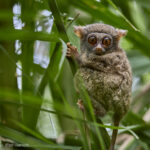
At last! My first pygmy tarsier on Sulawesi! Over the following three nights, I managed more than twenty sightings, although individual animals may have been observed more than once. Nevertheless, I was only able to photograph a single specimen satisfactorily. Compared with my experiences in Borneo, the animals were extremely shy and often disappeared even when approached cautiously. The Sunda pygmy lemur (Cephalopachus bancanus) had often proved much more tolerant during my previous encounters. Apparently, my night-time excursions were also unusual for the villagers. When we finally said our goodbyes and headed back to Wakai by boat, some locals called after me, laughing: “Jumpa lagi, Tarsius!” Roughly translated: “See you next time, Tarsius!” It seemed I’d earned myself a new nickname.


Second stop: Tarsius supriatnai in Bogani Nani Wartabone National Park
After returning to Gorontalo, our journey took us on to Bogani Nani Wartabone National Park, officially known as Taman Nasional Bogani Nani Wartabone. The protected area spans parts of the provinces of Gorontalo and North Sulawesi and is home to a remarkable variety of endemic animal species. Our destination was the Hungayono forest area, from where we hiked to a simple ranger station. The walk usually takes about one to one and a half hours. As I am used to long hikes through tropical rainforests, we reached the accommodation in less than an hour. As dusk fell, I naturally wanted to know straight away where the tarsiers were. A ranger led me to several large rattan palms, whose densely tangled shoots, armed with long spines, apparently served as sheltered daytime hiding places for the small primates.


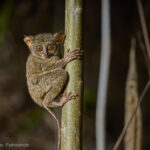
And indeed! Among the spines, we spotted the first animals, which were slowly leaving their sleeping spots in the last light of day and climbing up the leaf stalks. The ranger at the research station identified the pygmy tarsiers observed there as Tarsius supriatnai. This species was only scientifically described in 2017 by Myron Shekelle and his colleagues and named after the Indonesian primatologist and conservationist Jatna Supriatna. Its distinction from other North Sulawesi tarsiers is based in particular on morphological characteristics and its characteristic duet calls.
Tarsius supriatnai bears a very strong external resemblance to the species Tarsius spectrumgurskyae, which was also described in 2017. The differences described include certain proportions of the limbs, a relatively larger hairless area at the base of the ear, and differences in tail length. However, many of these characteristics are difficult to discern in the field. The species-specific vocalisations are therefore particularly helpful for scientific species identification.
Photographically, the encounter was once again an enormous challenge. The last of the daylight was already fading amongst the treetops, and the tarsiers were moving deftly through the dense tangle of rattan palms. Using very high ISO settings, slow shutter speeds and a great deal of patience, I finally managed to capture one of the animals on camera.
Following our ranger’s identification, I had thus found the second tarsier species of my trip. After several days in the national park, we said goodbye to our guides and set off on the long journey back to Gorontalo. From there, we continued on to Tomohon.


Third stop: Tomohon and the Tangkoko Nature Reserve
In Tomohon, the main focus was actually on volcano treks and searching for reptiles. I was particularly interested in the pit viper Tropidolaemus laticinctus, which is endemic to Sulawesi, but unfortunately I was unable to find it. Arno, the owner of the Rimba Eco Resort and a native of the Netherlands, organised a night-time walk for me, during which we did at least spot three pygmy tarsiers of the species Tarsius spectrumgurskyae. However, the animals were high up in the treetops and were almost impossible to photograph, even with fast lenses and long focal lengths. Their calls, audible from afar, accompanied us throughout the twilight hours. After two nights, our journey finally took us on to the Tangkoko Batuangus Nature Reserve (Cagar Alam Tangkoko Batuangus), one of the best-known protected areas in North Sulawesi.


On our way through Tangkoko, we passed an imposing bust of the British naturalist Alfred Russel Wallace (1823–1913). Erected in 2019, the monument commemorates one of the most significant pioneers of evolutionary biology, who travelled through this region as early as 1859 and studied its extraordinary wildlife. Wallace developed the theory of evolution by natural selection independently of Charles Darwin and is regarded as one of the founders of modern biogeography. Particularly well-known is the Wallace Line, named after him, which runs between Borneo and Sulawesi, amongst other places, and marks a remarkable boundary between the Asian and Australasian faunas. Sulawesi lies within the biogeographical transition region known as Wallacea, whose complex geological history has given rise to an extraordinary number of endemic species. The remarkable diversity of tarsiers is also a striking example of the evolutionary processes that Wallace sought to understand more than 160 years ago.
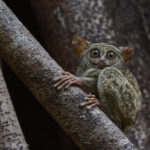
There are probably few places with conditions as favourable as these for observing Tarsius spectrumgurskyae. The local guides have known the tarsiers’ traditional roosting sites for many years and lead visitors directly to them. My guide, Stephan, showed me a large tree that was partly overgrown by a strangler fig (Ficus sp.). Numerous crevices and cavities had formed between the trunks and roots, which served as daytime hiding places for the small primates. However, this spot did not remain unvisited for long. Soon, more tourists arrived. During the peak season, I was told, up to eighty people can sometimes gather here around a single sleeping tree.
A few minutes after sunset, the first tarsiers began to call. Their surprisingly loud voices rang out from all directions before the little primates finally leapt out of the crevices in their sleeping tree. It was fascinating to observe these animals at close quarters and to hear their characteristic calls.
Tarsius spectrumgurskyae was named after the American primatologist Sharon Gursky, who spent many years researching the behaviour and ecology of the North Sulawesi tarsiers. The species has predominantly grey-brown fur, often with brownish patches on the thighs, and a long, dark tail tuft. Particularly distinctive, however, are its species-specific duet calls, through which males and females communicate using coordinated sequences of sounds.
Here, too, taking photographs proved challenging despite the relatively short distance. In low light, I needed a sturdy tripod, high ISO settings and slow shutter speeds. I deliberately avoided using a flash so as not to disturb the animals unnecessarily. Nevertheless, this was undoubtedly one of my most wonderful encounters with these fascinating little primates. I was particularly impressed by the volume at which these tiny animals communicated with one another.


A new goal: all the tarsiers in the world
After just under three weeks on Sulawesi, I had achieved my original goal. I was able to observe tarsiers in all three planned regions and, following identification on site, actually capture all three species I was looking for on camera. On the Togian Islands I encountered Tarsius niemitzi, in Bogani Nani Wartabone National Park the animals identified locally as Tarsius supriatnai, and finally Tarsius spectrumgurskyae in Tomohon and Tangkoko.
But by now my enthusiasm for these extraordinary primates had been firmly ignited. Numerous other species still await me on Sulawesi, including Tarsius dentatus, T. fuscus, T. lariang, T. pelengensis, T. pumilus, T. sangirensis, T. tarsier, T. tumpara and T. wallacei. In particular, the rare pygmy tarsier (Tarsius pumilus) from the montane rainforests of Central Sulawesi would be a fascinating encounter for me. Added to this is the Philippine tarsier (Carlito syrichta), whilst I have already been able to observe and photograph the Sunda tarsier (Cephalopachus bancanus) on Borneo on several occasions.
According to the current scientific classification, the tarsier family thus comprises 14 recognised species. And as taxonomic research is far from complete, more may be added in the future.
Perhaps I really should make it my life’s work to observe and photograph every tarsier species on Earth in its natural habitat. After all, there is hardly anything more fascinating than roaming through a tropical rainforest at night and suddenly spotting two enormous eyes amongst the leaves.
related posts: