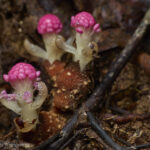
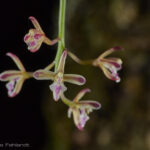
Male of Balanophora papuana Schltr. a parasitic flowering plant of the Balanophoraceae family – of Western Highlands / Papua New Guiniea – around 2500m ASL.
Balanophora papuana is a dioecious, achlorophyllous perennial root holoparasite in the family Balanophoraceae. Most of the plant consists of clustered, warty tubers attached to the roots of host plants, while reddish to yellowish male or female inflorescences emerge above the forest floor. Because it lacks chlorophyll, it cannot photosynthesise and obtains its nutrition from its host; recorded hosts include species of Macaranga and Ficus. Male flowers have been reported to open when touched. The species inhabits lowland evergreen and montane rainforests at approximately 300–2,500 metres and occurs from Peninsular Thailand through Malesia to New Guinea, including Papua New Guinea. It was described by Rudolf Schlechter in 1913 from New Guinean material. The generic name derives from the Greek balanos, meaning “acorn”, and phoros, meaning “bearing”, while the epithet papuana refers to its Papuan type locality.


related posts: