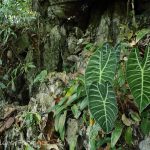
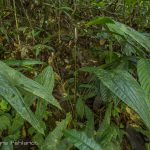
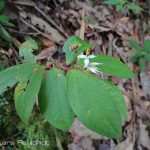
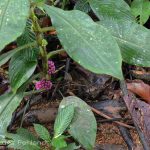
Alocasia longiloba var. Watsoniana of Sarawak / Borneo, around 600m ASL
Alocasia longiloba Miq. (Araceae) was validly described in 1856 in Flora van Nederlandsch-Indië (Volume 3: 207) and is listed as a separate species in current taxonomic references. According to Kew/Plants of the World Online, its documented natural range extends from southern China (including Guangdong and southern Yunnan) to western and central Malaysia, with occurrences reported as far as Peninsular Malaysia and further south to Sumatra and Borneo. The name Alocasia longiloba “Watsoniana”, which is also widely used in cultivation, is nomenclaturally related to the name Alocasia watsoniana Sander, which was published in 1893 in the Gardeners’ Chronicle (Series 3, Volume 13: 442) and is treated as a synonym of A. longiloba in Kew/POWO; Corresponding illustrations classify this “watsoniana” form within the A. longiloba complex and explicitly link it to Borneo (as well as Sumatra) in the documented illustration/collection tradition.
Etymologically, the genus name Alocasia is explained as a distinction from *Colocasia (a– ‘without’ + colocasia), the species epithet longiloba means ‘with long lobes’, and watsoniana is an adjective formed from a person’s name with the ending –iana commonly used in botanical Latin.
*The name Colocasia (introduced botanically by H. W. Schott, 1832) is a Latinisation of the Greek plant name kolokasía or kolokásion. This Greek name is often interpreted in specialist literature as a loanword from the Middle East (older forms such as colcas/culcas and the Arabic qulqās are mentioned, among others), without it being possible to further break down its origin with certainty. In ancient tradition, kolokasia initially referred to the (sacred) lotus as an edible ‘lotus root’; later, there was a shift in meaning, so that in late antique texts the name also referred to taro. The Latin colocasia eventually became the botanical genus name Colocasia.

related posts: