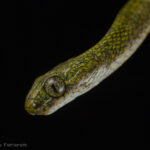
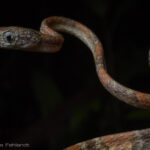
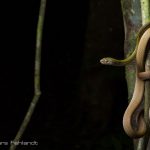
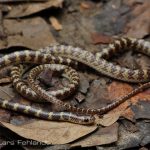
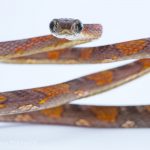
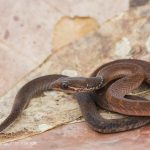
White-spotted cat snake, Boiga drapiezii (H. Boie in F. Boie, 1827) of south-Sarawak / Borneo highland around 1050m ASL.
Boiga drapiezii (H. Boie in F. Boie, 1827) is an opisthoglyphous (rear-fanged), egg-laying snake from the Colubridae family; its type locality is Java. Within its (Sundaic) distribution, the species is known from Borneo, among other places; photographic evidence is available for Sarawak (Borneo, Malaysia).
The species name drapiezii honours Pierre Auguste Joseph Drapiez (1778–1856), a Belgian naturalist. Morphologically, it is described as very slender and somewhat flattened laterally; the maximum length is given as 210 cm, and two clearly distinguishable colour forms (including reddish-brown vs. grey-green) are reported, which are not thought to correlate with sex or size.
In terms of its lifestyle, B. drapiezii is described as arboreal (tree-dwelling) and found in lowland primary, secondary and swamp forests up to about 1,100 metres above sea level. Its diet is documented as consisting of large insects, frogs, tree-dwelling lizards (e.g. Draco ssp), birds and bird eggs. For reproduction, clutches of about 4–10 eggs are mentioned, which are said to be laid in arboreal termite nests or in termite-infested wood, among other places.
As with other rear-fanged vipers, the ‘venom’ comes from the Duvernoy’s gland; B. drapiezii is classified as ‘mildly venomous’. Experimentally, its secretion/venom showed a postsynaptic neuromuscular effect in vitro (including in a chick muscle preparation), i.e. an effect on neuromuscular transmission; in addition, α-neurotoxic activity is discussed in the context of three-finger toxins.


related posts: