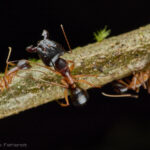
Fish Hook Ant, Polyrhachis ypsilon Emery, 1887 of Sarawak / Borneo – around 1200m ASL
Polyrhachis ypsilon Emery, 1887 is an ant species of the subfamily Formicinae (tribe Camponotini) from the genus Polyrhachis (subgenus Polyrhachis) and is assigned to the bihamata species group; Synonyms include Polyrhachis ypsilon victoris Santschi, 1925 and Polyrhachis synacantha Santschi, 1933. According to one compilation, the species name ‘ypsilon’ refers to the fact that the long, curved hooks on the petiolus resemble the Greek letter ϒ (‘Ypsilon/Upsilon’) in shape. According to Kohout (2014), the species is large and characterised by relatively massive pronotal spines, widely diverging petiolar spines at the base, dense hairiness and golden pubescence; in addition, specimens across the distribution area are described as morphologically very similar. The known distribution includes the Malay Peninsula, Singapore, Borneo and Sumatra. For Borneo, field evidence is available from Sabah, among other places: in a study on ant–hemipteran trophobiosis in a lowland dipterocarp forest in the Danum Valley Conservation Area (Sabah, Malaysia), P. ypsilon was recorded as a tending ant on honeydew-producing hemipterans. There, P. ypsilon was involved in trophobiosis with Membracidae (treehoppers), Cicadellidae (leafhoppers) and Coreidae (plant bugs); the data table shows the activity in these trophobioses during the day. In another data set from Danum Valley (July–October 2004), P. ypsilon is also documented as occurring trophobiotically (including with Membracidae, Cicadellidae and Coreidae). Since honeydew is defined in this context as a sugary excretion of plant sap-sucking hemipterans and is directly absorbed by ants in trophobiosis, honeydew is a documented food resource for P. ypsilon in Borneo. In addition, a trail-sharing association has been experimentally investigated: in behavioural assays, workers of Dolichoderus cuspidatus regularly followed the pheromone trails of P. ypsilon; interspecific aggression between P. ypsilon, Camponotus saundersi and D. cuspidatus was highly asymmetrical, with C. saundersi described as submissive to the other two species, and the species distinguished between partners from the same vs. a different location (indicating habituation to trail-sharing partners). In a study of ant communities in the tree canopy of a primary rainforest in Danum Valley, P. ypsilon was detected on several of the trees studied (including presence on 6 of 20 trees; numerical dominance on 1 tree). An identification guide for the ants of the Sabangau peat swamp forest (Central Kalimantan, Borneo) also lists P. ypsilon and links the species to habitat presence data within the peat swamp habitat type matrix used there.

related posts: