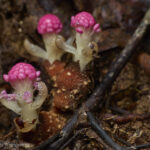
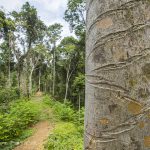
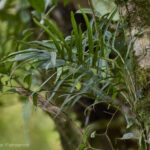
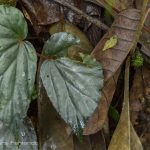
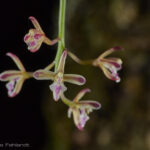
Mistletoe fig, Ficus deltoidea of Sarawak/Borneo – around 1400m ASL.
Ficus deltoidea Jack (Moraceae) is an accepted species that was first described by William Jack in 1822 in Malayan Miscellanies (2(7): 71). In the Kew taxonomic reference (Plants of the World Online), it is listed with two accepted subspecies (subsp. deltoidea and subsp. motleyana); Ficus diversifolia var. deltoidea (Jack) Ridl. is listed as a homotypic synonym. In its natural distribution, the species ranges from the Thai peninsula to Malaysia; Borneo, Java, Malaya, Sumatra, Sulawesi and the Moluccas are explicitly mentioned as native locations. For Borneo, F. deltoidea is described as part of a variable group of forms (‘F. deltoidea complex’); Corner (1969) presents a particularly large diversity of forms/varieties for Borneo and discusses the probable origin of the group of forms in Borneo on the basis of biogeographical patterns. According to Corner, the growth is often shrubby (with ascending branches and spirally arranged leaves) and in Borneo also includes occurrences in exposed locations from sandy beaches and sea cliffs to higher altitudes; in particular, the clade he refers to as var. motleyana, is reported for coastal, peat swamp and kerangas (heath forest) in Borneo, where it can grow to a tree-like height of about 6 m. Corner cites nutrient-poor, acidic, well-drained substrates as preferred locations; common habitats include dunes and rocks on the sea coast, quartzite ridges, washed-out limestone hilltops, mountain and mossy forests, as well as epiphytic growth forms.
Etymologically, the genus name Ficus comes from the Latin for “fig/fig tree”; the species epithet deltoidea refers to a (frequently) delta/triangle-like leaf shape (alluding to the Greek letter delta), and the common name “mistletoe fig” refers to its epiphytic growth.


related posts: