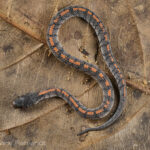
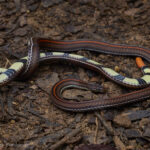
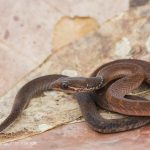
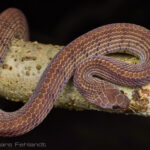
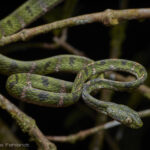
Smooth-scaled death adder, Acanthophis laevis Macleay, 1878 – of central Province / Papua New Guinea – around 800m ASL
Acanthophis laevis Macleay, 1877, commonly known as the Smooth-scaled or New Guinea Death Adder, is a stout, terrestrial and highly venomous elapid snake found in Papua New Guinea, Indonesian New Guinea, Seram and the Tanimbar Islands. Adults are generally about 49–59 cm long and have a broad, angular head, relatively smooth dorsal scales and a short, thin tail ending in a conspicuous spine-like tip. The generic name Acanthophis combines the Greek words akantha, meaning “spine”, and ophis, meaning “snake”, referring to the terminal tail spine, while the Latin specific epithet laevis means “smooth” and refers to its comparatively smooth scales. Like other death adders, it is primarily an ambush predator that remains camouflaged on the ground and attracts potential prey by moving its contrasting tail tip as a caudal lure. Available dietary data from Papuan death adders indicate that frogs and lizards form the principal prey, although birds and small mammals are also taken; these studies combined specimens from the A. laevis and A. rugosus lineages because some preserved individuals could not be identified reliably to species. The species produces live young and possesses predominantly neurotoxic venom capable of causing severe paralysis following envenomation.


related posts: