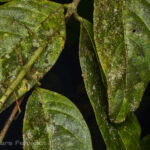
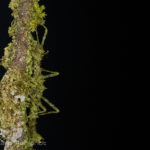
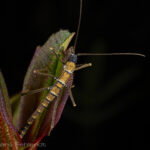
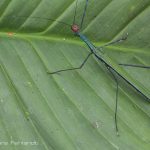
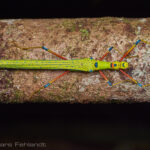
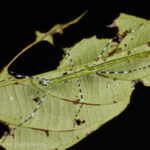
Stick insect, Phenacephorus cornucervi Brunner von Wattenwyl, 1907 of Sarawak / Borneo around 1200m ASL.
Phenacephorus cornucervi was described in 1907 by Karl Brunner von Wattenwyl. The species is reported to occur in Sabah and Sarawak in Borneo; field evidence comes from the vicinity of the Mount Kinabalu national park headquarter area (approx. 1580 m). The species was subsequently also bred in captivity. Morphologically, females have conspicuous, partly paired lobe- or comb-like structures on the back of the head and a strongly structured, granular to tuberculous body surface, supplemented by numerous lobe-like (partly ‘foliaceous’) extensions on the body and legs. In living females, large dark green tubercles on the body and a marbled pattern on the legs have also been described. It is precisely these irregular, moss- or lichen-like surface structures and appendages that can visually ‘dissolve’ the body contour and thus support camouflage (crypsis) in the substrate (e.g. mossy bark and epiphytic vegetation). The body length is given as 71–89 mm (females) and 60–70 mm (males). Breeding reports (PSG 73) emphasise that females have ‘many flaps’ and that some females may have small green, moss-like structures on their heads; In addition, several colour forms (including black, brown and beige) are mentioned. The literature also mentions a pronounced intraspecific variability of the ‘ornamental’ characteristics in P. cornucervi, which is said to have been observed even within the same clutch and in animals reared in captivity. Specific information on their diet is available from terrarium husbandry: blackberry (Rubus spp.), rose (Rosa spp.), raspberry (Rubus idaeus), privet (Ligustrum spp.) and ivy (Hedera helix) are mentioned as food plants; hazel and oak are also listed as acceptable. The species epithet cornucervi is Latin and is composed of cornu (‘horn’) and cervus (‘deer’), thus referring to the horn-like features of the head ornamentation.


related posts: