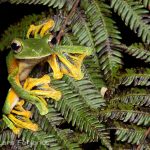
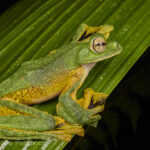
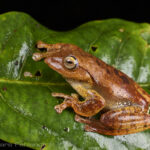
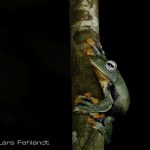
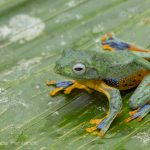
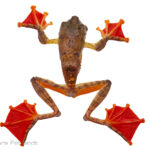
Wallace’s flying frog, Rhacophorus nigropalmatus Boulenger, 1895
Rhacophorus nigropalmatus (Rhacophoridae) is a tree-dwelling ‘flying/gliding frog’. The type locality of the species is the Akar River in Sarawak. The genus name Rhacophorus is etymologically derived from the Greek rhakos (‘flap, shred’) and the suffix –phorus (‘carrying’). The species epithet nigropalmatus is of Latin origin (including niger = ‘black’) and refers to the dark webbing (especially on the hands and feet), which is a diagnostic feature of the species.
The species is very large for a tree frog (up to approx. 90 mm SVL in males, up to approx. 100 mm SVL in females) and mainly lives high up in the canopy layer of primary lowland rainforests; it is most often observed when it moves to lower vegetation layers or bodies of water for reproduction. Morphologically, large adhesive discs on the fingers/toes, fully webbed hands and feet, and skin flaps on the forearm and tarsus are described; the interdigital membranes are black at the base and yellowish towards the outside. The behaviour that gives it its name is controlled gliding during jumps.
Reproduction takes place in stagnant waters in the forest; in Borneo, the use of forest pools such as wild boar wallows, among other ponds. Breeding behaviour involves the construction of a foam nest: the female produces a secretion and beats it with her hind legs to form foam, into which the eggs are laid while the male fertilises them at the same time; the nest is attached to leaves/branches above the water (or also to banks/mud banks). After embryonic development, the foam nest disintegrates, the larvae fall into the water and develop there until metamorphosis.


related posts: