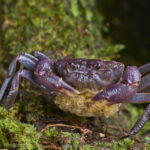
The coconut crab, Birgus latro – of the Togian Islands in Central Sulawesi / Indonesia around 20m ASL.
The coconut crab (Birgus latro), also known as the palm thief, is the largest terrestrial arthropod on Earth. Adult specimens can have a leg span of over one metre and weigh more than four kilograms.
Despite its crab-like appearance, the coconut crab belongs to the family Coenobitidae. Whilst juveniles initially use empty snail shells for protection, adults develop a heavily calcified abdomen and no longer require a shell.
Particularly remarkable are its enormously powerful claws, with which it can even crack open coconuts. However, its diet consists mainly of fruit, seeds and other organic matter, and occasionally of carrion and smaller animals.
I was able to observe this extraordinary species near Bomba on the Togian Islands. Although coconut crabs are almost entirely adapted to life on land, their reproduction remains linked to the sea, as their larvae initially develop in water.
Due to intensive hunting and the loss of suitable habitats, Birgus latro is now classified as ‘Vulnerable’ by the IUCN. Populations on the Togian Islands have also already been scientifically studied.


related posts: